Venue: ROYAL THEATER
(53 Akti Dymaion Street [Former Poorhouse], Patras. T.: 2611810524)
Play by: Manos Lambrakis
Preparation and Direction: Andreas Thanasoulas
Performed by: Theatre Group of the Open Care Centres for Older People (KAPI) of the Municipality of Patras
Song Instruction: Christos Exarxos
Songs Performed by: Choir of the Open Care Centres for Older People (KAPI) of the Municipality of Patras
A lost diary becomes the starting point for an imagined return to the inner world of Aliki Vougiouklaki.
Behind the brilliance of her public image, we seek the woman who lived between her personal truth and the expectations of an entire nation.
Fiction attempts to bridge the distance between the person and the icon, between life and its representation.
Memory, fame, loneliness, and the passage of time form the landscape of an imagined confession.
The diary makes no claim to the authenticity of a historical document; instead, it offers a space in which everything that the public image may have left unspoken can find a voice.
And it raises a question that reaches beyond this particular figure: how much do we truly know of the human being behind the myth we ourselves have created?
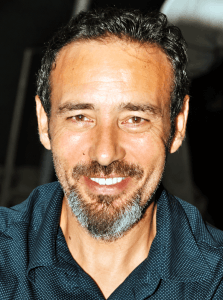
Manos Lambrakis
| MANOS LAMBRAKIS - Playwright, Dramaturg, Translator Manos Lambrakis was born in 1978 in Heraklion, Crete. He studied Archaeology and Art History at the National and Kapodistrian University of Athens, followed by studies in the Archaeology of the Eastern Mediterranean, Egypt and the Aegean (University of the Aegean), Cultural Management (University of Athens), Theatre History (University of Warwick) and Theology (Aristotle University of Thessaloniki). From 2000 to 2013, he was an artistic collaborator of Lefteris Voyiatzis and his theatre company, Nea Skini. His first play, Happy Birthday, was staged in 2002 by the Nees Morfes theatre company and represented Greece at the 11th Biennale of Young Artists from Europe and the Mediterranean. In 2004, he served as an Art History consultant for the “Clepsydra” sequence of the Opening Ceremony of the Athens Olympic Games, under the artistic direction of Dimitris Papaioannou. His play Puerto Grande (2005) was staged in 2009, directed by Roula Pateraki. The play was nominated for the Karolos Koun Award for Best Modern Greek Play, while Roula Pateraki received the Karolos Koun Award for Best Direction of a Modern Greek Play. His other works include Pferdetanz (2010), Yalta (2017), For Eros Is Like Water (2019), Sara(h)(2020) and Glaukos (2021). He has translated Georg Büchner’s Woyzeck, Samuel Beckett’s Happy Days and Sarah Kane’s Crave. His work as a dramaturg and director includes directing Scenes (2014), collaborating with Roula Pateraki on the dramaturgy, writing and composition of Post Inferno – Towards Damascus (2016), participating in Loula Anagnostaki Worksite – The Red Performance (2018), and undertaking the dramaturgical adaptation of The Bacchae (2021). He has collaborated with the National Theatre of Greece, Onassis Stegi, the Athens and Epidaurus Festival, the Karolos Koun Art Theatre and Eleusis 2023 – European Capital of Culture. His published books include TRIA (Syrtari, 2021), The Lost Diary of the “Other” (Astarti, 2022) and The Fissure and the Face: Writings from the Silence of Time (Ropi, 2026). He also contributed to the collective volume Karamanlis – Politics as Creation (2023) and, in 2025, wrote a text for Fragilities, the catalogue of the 66th Thessaloniki International Film Festival. Alongside his theatrical work, he writes essays and articles exploring the relationships between language, the body, desire, memory and human experience, often in dialogue with literature, history, philosophy and theology. | |
| ANDREAS THANASOULAS - Actor – Director – Playwright – Educator Andreas Thanasoulas was born in Varda, Elis, in 1969 and lives in Patras. He studied Acting at the Athens Drama School and at the Theatre Workshop of Vasilis Diamantopoulos, Education at ASPETE, and Theatre Studies at the University of Patras. He pursued postgraduate studies in Creative Writing at the University of Western Macedonia, where he was awarded a PhD in 2025. His doctoral dissertation examines representations of labour in post-war Greek drama. He has worked as an actor, director, playwright and educator. He has collaborated with the Municipal and Regional Theatre of Patras (DI.PE.THE. Patras) and has staged his own theatrical works. He has also served as Artistic Director of the Theatre Stage at the “Politeia” Cultural Centre. His literary work includes the novel Wind in the Eyes (Anemos sta Matia) and several plays, among them The Collector (O Syllektis), which won First Prize for Best Text at the Athens Fringe Festival. He has also received recognition for his short fiction. He teaches Playwriting and Screenwriting at the Hellenic Open University and Playwriting in a postgraduate programme at the University of Western Macedonia. | |
| TEATRE GROUP OF OPEN CARE CENTERS FOR OLDER PEOPLE The Theatre Group of the Open Care Centres for Older People (KAPI), operating under the Social Welfare Organisation of the Municipality of Patras (KODIP), began its creative journey in 2014. Its establishment was the result of a fruitful collaboration between KODIP’s Department for Older People and the Municipal and Regional Theatre of Patras (DIPETHE), under its successive artistic directors. The group was founded as a vibrant means of expression, communication and creativity. Through theatrical practice, its members strengthen their concentration, develop personal connections, enjoy creative recreation, cultivate a sense of acceptance and engage with the cultural heritage of their community. Regular two-hour weekly theatre classes and workshops are held at the First KAPI Centre (Prosfygika) and the Second KAPI Centre (Agyia). Under the guidance and instruction of experienced theatre practitioners and collaborators of DIPETHE, these workshops have resulted in a series of successful productions warmly received by audiences. Productions The group's repertoire includes the following productions:
These productions have been presented at prominent cultural venues in Patras, including the Apollon Municipal Theatre, the Barry Theatre, the Pan-Asia Minor Association, the Old Municipal Hospital and the Cultural Centre at the Old Fish Market. The group has also developed a strong presence beyond the city, presenting its work in other communities and educational settings. In 2017, following an invitation from the Municipality of Nemea, the group performed One More Encounter, directed by Spyros Kouvardas, at the amphitheatre of Nemea General Lyceum. In 2018, at the invitation of the KAPI Centre of Agios Dimitrios in Agrinio, the group travelled to Agrinio to present The Rubbish People, written and directed by Spyros Kouvardas. In 2025, responding to an invitation from the 60th Primary School of Patras, the group presented Theatrical Antics in the Folds of Time to pupils in the fifth and sixth grades, creating a moving connection between generations. The group also actively preserves local traditions. In 2024, 2025 and 2026, it staged three successful Carnival performances at KAPI centres, seeking to revive the spirit of the traditional Patras Carnival through satire, spontaneity and the genuine innocence of a bygone era. Throughout its history, the driving force and coordinator of the Theatre Group has been social worker Pelagia Tsoukalohoritou. Beyond her coordinating role, she has made a decisive contribution to scriptwriting, artistic guidance and the overall organisation of the group's activities. The staff of the Department for Older People, together with KODIP's various services, including its Administration and Finance Department, have consistently provided invaluable support, helping to ensure the success of every production. Heartfelt thanks are due to everyone who has contributed in any way to this theatrical journey. The group's long history has not been without difficulties. Yet the enthusiasm, tireless determination, perseverance and vitality of its members, aged between 65 and 88, have always proved stronger than any obstacle. These amateur actors continue to overcome challenges and pursue their creative aspirations, embodying the words attributed to the philosopher Seneca: “How unfortunate is the elderly person who has nothing to show for their life but their years.” |